
- rolling suds
Pressure Cleaning Explained: Is It the Same as Pressure Washing?
A Quick Answer: Pressure cleaning and pressure washing are often used interchangeably, but they are not always technically identical. Both methods use high-pressure water (measured in PSI and GPM) to remove dirt, mold, and contaminants, but the distinction usually comes down to water temperature and application technique.
From a technical standpoint:
A 2025 exterior maintenance report found that heated water systems can improve grease and oil removal efficiency by up to 50% compared to cold water alone, which explains why pressure washing or power washing is often preferred for commercial or heavy-duty cleaning tasks. |
The terms pressure cleaning and pressure washing are often used interchangeably, but this overlap can create confusion for property owners trying to choose the right cleaning method. Many assume both processes deliver identical results, yet differences in water temperature, technique, and application can significantly impact cleaning effectiveness, especially on surfaces with grease, mold, or embedded buildup.
A 2025 facilities maintenance report found that nearly 70% of property owners are unsure which exterior cleaning method is being used when booking a service, leading to mismatched expectations and inconsistent results. Another study highlighted that heated water systems can reduce cleaning time on oil-stained surfaces by up to 40%, demonstrating how method selection directly affects performance.
At a technical level, both methods rely on controlled pressure and water flow to remove contaminants, but how that force is applied and enhanced determines the outcome. Factors like surface type, level of buildup, and environmental exposure all influence whether standard pressure cleaning or a more advanced pressure washing approach is required.
Understanding this distinction is not just about terminology. It helps property owners make informed decisions, avoid surface damage, and achieve more efficient cleaning results across a range of outdoor applications.
What Is Pressure Cleaning and How Does It Work?
Pressure cleaning is a general term for the process of removing dirt, debris, and other contaminants from surfaces using high-pressure water. It focuses primarily on the mechanical force generated through water velocity to break the bond between the surface and unwanted buildup.
Basic Mechanism of High-Pressure Water Cleaning
At its core, pressure cleaning works by forcing water through a narrow nozzle at high speed. This creates a concentrated stream that dislodges particles such as dust, mud, algae, and loose debris. The effectiveness of this process depends on how pressure is distributed across the surface and how consistently the spray is applied.
Unlike chemical-heavy methods, pressure cleaning relies more on physical impact, making it suitable for general cleaning tasks where contaminants are not deeply embedded.
Where the Term “Pressure Cleaning” is Commonly Used
The term is often used broadly in both residential and commercial contexts. In many regions and industries, “pressure cleaning” serves as an umbrella term encompassing various high-pressure cleaning techniques, regardless of whether heated water or detergents are used.
This flexible usage is one reason for confusion, as the term does not always specify the exact cleaning method or equipment involved.
Typical Applications in Residential and Commercial Settings
Pressure cleaning is commonly applied to surfaces that can handle moderate to high pressure without requiring specialized treatment. These include driveways, sidewalks, patios, and exterior walls where dirt and environmental buildup accumulate over time.
In commercial environments, it is often used for routine maintenance cleaning where speed and surface-level removal are the primary goals rather than deep stain treatment.
What Is Pressure Washing and How Is It Different?
Pressure washing is a more defined cleaning method that builds on basic pressure cleaning by incorporating controlled pressure, higher water flow, and in many cases, heated water and detergents. This combination allows it to remove not only surface-level dirt but also grease, oil, and biological growth that standard pressure alone may not fully eliminate.
A 2025 cleaning systems report found that combining pressure with detergents improves contaminant removal efficiency by more than 35%, particularly on surfaces exposed to organic buildup, such as mold and algae.
Core Principles of Pressure Washing
Pressure washing works by combining mechanical force with chemical and thermal support. Instead of relying only on water impact, it enhances cleaning through controlled application.
- High-pressure water breaks the bond between contaminants and surfaces
- Detergents penetrate and loosen embedded dirt, grease, and organic growth
- Heated water, when used, accelerates the breakdown of stubborn substances
- Consistent spray patterns ensure uniform cleaning without streaking
This layered approach makes pressure washing more effective for deep cleaning than basic pressure cleaning.
Role of PSI, GPM, and Cleaning Agents
Pressure washing performance is determined by how pressure, flow rate, and cleaning solutions work together. PSI controls the spray intensity, while GPM determines how quickly contaminants are flushed away.
- Higher PSI increases impact force for tougher buildup
- Higher GPM improves rinsing speed and coverage
- Detergents reduce reliance on excessive pressure
- Proper balance prevents damage while maximizing efficiency
A 2025 equipment performance study showed that systems with optimized PSI and GPM combinations can reduce cleaning time by up to 30% while maintaining surface safety.
Surfaces Commonly Cleaned with Pressure Washing
Pressure washing is used across a wider range of surfaces due to its adaptable approach. It is particularly effective where contaminants are more resistant or deeply embedded.
- Concrete surfaces with oil stains and heavy dirt accumulation
- Exterior siding exposed to mold, mildew, and environmental buildup
- Decks and fences requiring controlled but thorough cleaning
- Commercial areas with grease, residue, or high-traffic wear
This versatility is what distinguishes pressure washing as a more advanced and targeted cleaning method compared to general pressure cleaning.
Pressure Cleaning vs Pressure Washing Comparison
Feature | Pressure Cleaning | Pressure Washing |
Definition | General term for cleaning surfaces using high-pressure water | Specific method using pressure with a controlled technique, often including detergents and heat |
Water Temperature | Typically uses cold water | Can use cold or heated water for enhanced cleaning |
Cleaning Approach | Relies mainly on mechanical force | Combines pressure, detergents, and sometimes heat |
Effectiveness | Best for surface-level dirt and debris | More effective for grease, oil, mold, and deep stains |
Equipment Complexity | Simpler setup with basic attachments | Advanced systems with chemical application and temperature control |
Common Use Cases | Driveways, sidewalks, patios (light to moderate cleaning) | Siding, decks, commercial areas, and heavy-duty cleaning tasks |
Risk Level | Moderate if pressure is misused | Lower when detergents reduce the need for high pressure |
Cleaning Efficiency | Suitable for routine maintenance | Higher efficiency for deep cleaning and faster results |
When Should You Use Pressure Cleaning Vs Pressure Washing?
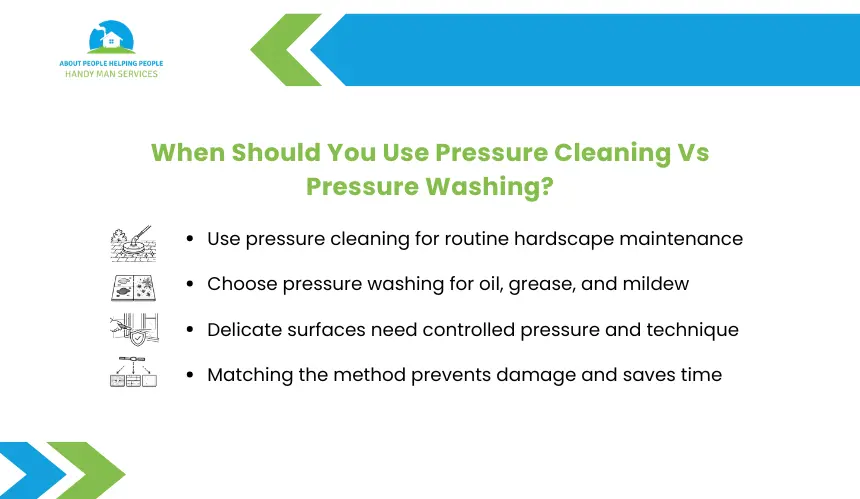
Choosing between pressure cleaning and pressure washing depends on the surface type, the nature of the buildup, and the level of cleaning required. While both methods use pressurized water, they are not always equally effective across different conditions. The right choice improves cleaning performance, reduces surface risk, and prevents unnecessary time and water use.
Best Use Cases For Pressure Cleaning
Pressure cleaning is generally the better option for surfaces with loose dirt, dust, mud, and routine environmental buildup. It works well when the main objective is surface restoration rather than deep contaminant removal.
This method is commonly used for sidewalks, patios, driveways, boundary walls, and other hard surfaces that can tolerate direct pressure. For routine exterior maintenance, pressure cleaning is often sufficient because the contaminants are usually surface-level and do not require heat or stronger chemical support.
A 2025 exterior care report found that routine cold-water high-pressure cleaning remains effective for most residential hardscape maintenance when grease and organic staining are not the primary issue.
Situations Where Pressure Washing Is More Effective
Pressure washing becomes more effective when the surface is affected by grease, oil, algae, mildew, or embedded grime that cannot be removed efficiently with water force alone. In these cases, the addition of detergents and, where applicable, heated water improves breakdown and lifting of stubborn contaminants.
This makes pressure washing more suitable for commercial walkways, heavily used driveways, siding with biological growth, decks with embedded dirt, and areas exposed to repeated moisture or traffic. It is also the preferred method when cleaning speed and deeper restoration are important.
A 2025 maintenance efficiency study found that detergent-assisted pressure washing improved the removal of organic buildup on exterior surfaces by more than one-third compared to pressure-only methods.
Factors That Influence The Right Choice
The decision should always be based on how the surface responds to applied force and on the type of contamination present. Hard, durable materials can usually handle direct pressure more easily, while delicate surfaces may require a more controlled approach. The depth of staining also matters, since surface dust and mud respond differently from grease or algae.
Other important factors include the age of the surface, the presence of coatings or paint, exposure to local weather, and whether the goal is basic maintenance or more thorough restoration. Understanding these variables allows property owners to choose a cleaning method that delivers better results without creating avoidable damage.
Common Misconceptions About Pressure Cleaning And Pressure Washing
Misunderstandings around these terms often lead to incorrect service selection, inefficient cleaning, or unrealistic expectations. Clarifying these misconceptions helps property owners make more informed decisions and avoid unnecessary surface damage or wasted effort.
Are They Completely Different Methods?
Pressure cleaning and pressure washing are not entirely separate methods. In many cases, they overlap and may even use similar equipment. The difference lies in how the process is applied. Pressure cleaning is a broader term, while pressure washing typically refers to a more structured approach that may include detergents and temperature control. The core principle of using pressurized water remains the same in both.
Is One Stronger Than The Other?
Neither method is inherently stronger. Cleaning strength is determined by the combination of pressure, flow rate, and technique. Pressure washing can appear more powerful because it often uses detergents or heated water, which improve cleaning efficiency without increasing raw pressure. In contrast, pressure cleaning relies more on direct force, which can be less effective on deeply embedded contaminants.
A 2025 cleaning performance study showed that chemical-assisted cleaning methods can achieve better results at lower pressure levels, reducing the risk of surface damage while maintaining effectiveness.
Does Terminology Vary By Region Or Industry?
Terminology differences are common across regions and service providers. In some areas, pressure cleaning and pressure washing are used interchangeably, even when the actual methods differ. This inconsistency can create confusion when comparing services or requesting specific cleaning techniques.
Understanding that these terms may describe similar or slightly different processes depending on the provider helps property owners ask more precise questions and ensure the correct method is applied to their property.
Rolling Suds delivers professional exterior cleaning services using controlled pressure, surface-specific techniques, and efficient cleaning systems to ensure consistent results. Their approach focuses on matching the right method to each surface, whether it requires standard pressure cleaning or more advanced pressure washing. Property owners can rely on their team for safe, efficient cleaning that protects materials while improving overall appearance. Learn more or schedule a service through their Los Angeles page.
Frequently Asked Questions
What is the main difference between pressure cleaning and pressure washing?
The main difference lies in application. Pressure cleaning generally refers to using high-pressure water alone, while pressure washing may include detergents and heated water to improve the removal of grease, mold, and embedded contaminants.
Is pressure washing better than pressure cleaning?
Neither method is universally better. Pressure washing is more effective for deep cleaning and stubborn buildup, while pressure cleaning works well for routine maintenance and surface-level dirt removal.
Can both methods be used on all surfaces?
Not all surfaces can handle the same level of pressure. Hard surfaces like concrete can tolerate direct pressure, while delicate materials such as siding or roofing may require lower pressure or soft washing techniques.
Do professionals use both pressure cleaning and pressure washing?
Professional cleaning services typically use both methods depending on the surface and type of contamination. They adjust pressure, detergents, and techniques to achieve the best results safely.
Why do some companies use the terms interchangeably?
The terms are often used interchangeably because they share a common core process: using pressurized water. However, differences in technique, equipment, and application can still vary by service provider.